
We may earn a commission if you buy through links on this page, at no extra cost to you. How we make money
If you have already decided on an Autonomous chair, the four ErgoChairs are not a good-better-best ladder. They are four different answers to one question: where do you want the support to come from, and how much do you weigh?
My short version: the ErgoChair Pro is the default, the Ultra 2 is the better buy for heavier and shorter people, the Mesh is the hardest one to justify, and the Core is a budget chair with a budget warranty.
Research note: AI-assisted research and writing, not hands-on tested. Written by Rhett Varley. No chair was sat in, assembled or tested for this page. Every call below is a judgment from Autonomous's US product pages and its chair comparison page, checked on November 16, 2026. Prices change often; treat them as "as of Nov 16, 2026." All four pages were showing Black Friday sale prices that day, and Autonomous says its trial and return policy does not apply to flash-sale items or limited-time deals, so confirm the return terms at checkout. The Autonomous links on this page are affiliate links (we may earn a commission), and nobody paid for placement (how we research).
Quick answer
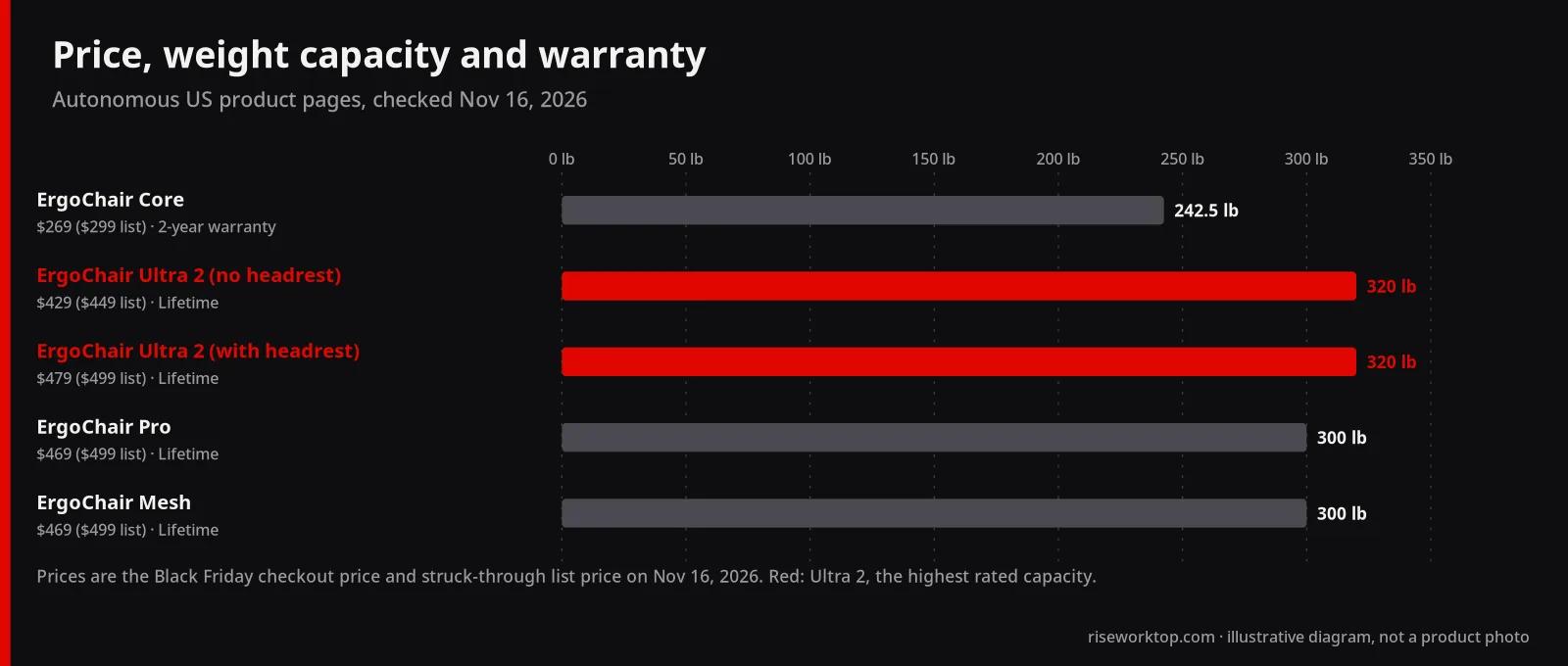
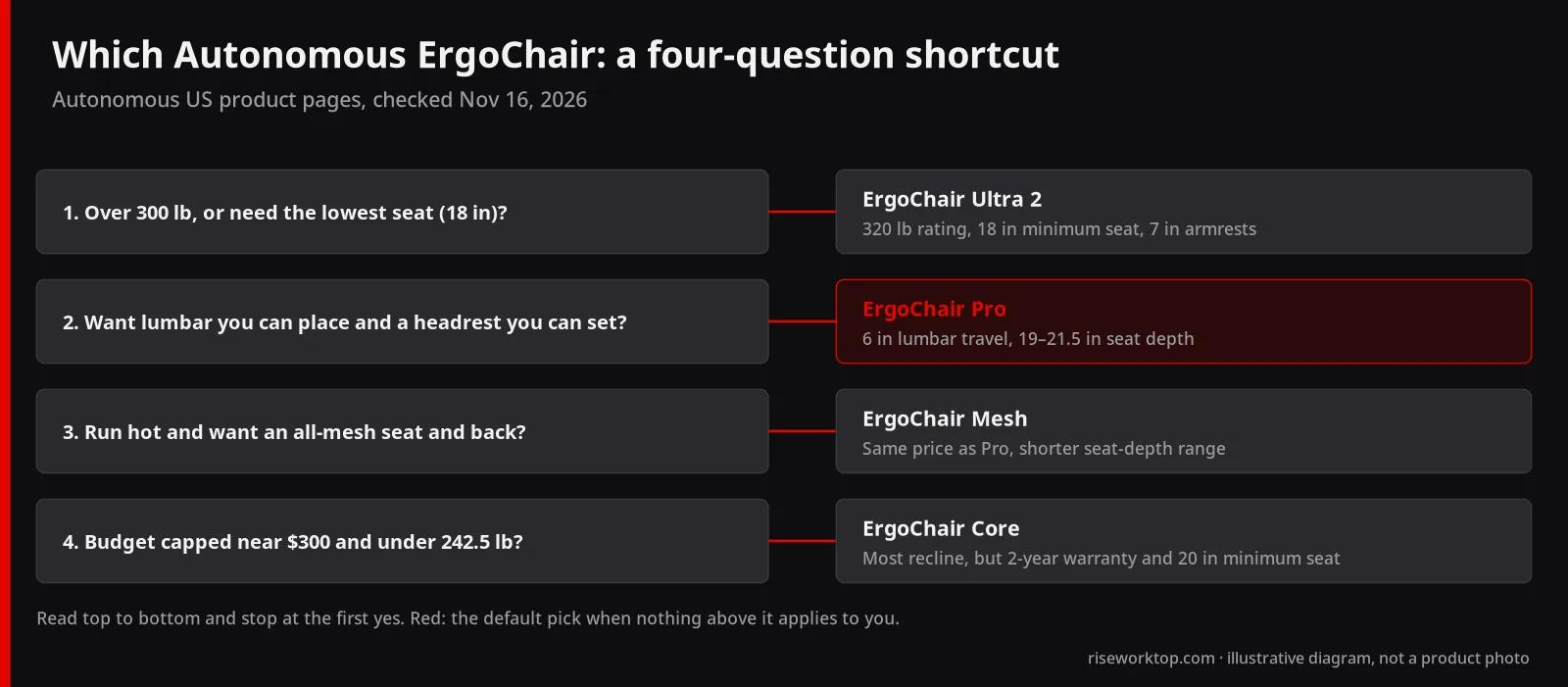
Buy the ErgoChair Pro if you want one chair that suits most people: a lumbar pad that slides through a 6-inch range, an adjustable headrest, a 19–21.5-inch seat-depth range, a 300 lb rating and a lifetime warranty, at $469 ($499 list) on November 16, 2026. Choose the ErgoChair Ultra 2 instead if you weigh more than 300 lb (it is rated to 320 lb), need the lowest seat in the lineup (18 inches), or would rather have a flexing backrest than a lumbar knob; it is $429 without a headrest and $479 with one. Choose the ErgoChair Core only if your budget stops near $300: it is $269 ($299 list) but rated to 242.5 lb, starts at a 20-inch seat height and carries a 2-year warranty instead of lifetime. The ErgoChair Mesh costs the same as the Pro and gives you an all-mesh seat and back, but a shorter seat-depth range; buy it only if you run hot.
If you are still choosing between brands, start with our ergonomic office chair under $400 guide, which covers fit checks and other makers.
Quick comparison
All figures are from Autonomous's US product pages, checked November 16, 2026. "Sale" is the live checkout price that day; "list" is the struck-through price on the same page. Armrest heights are measured from the seat. Recline is the tilt range on each product page; the comparison page states the same chairs as 115° (Ultra 2), 112° (Pro) and 130° (Core) back angles.
| Model | Sale / list | Capacity | Seat height | Seat depth range | Lumbar | Armrests | Headrest | Recline range | Warranty |
|---|---|---|---|---|---|---|---|---|---|
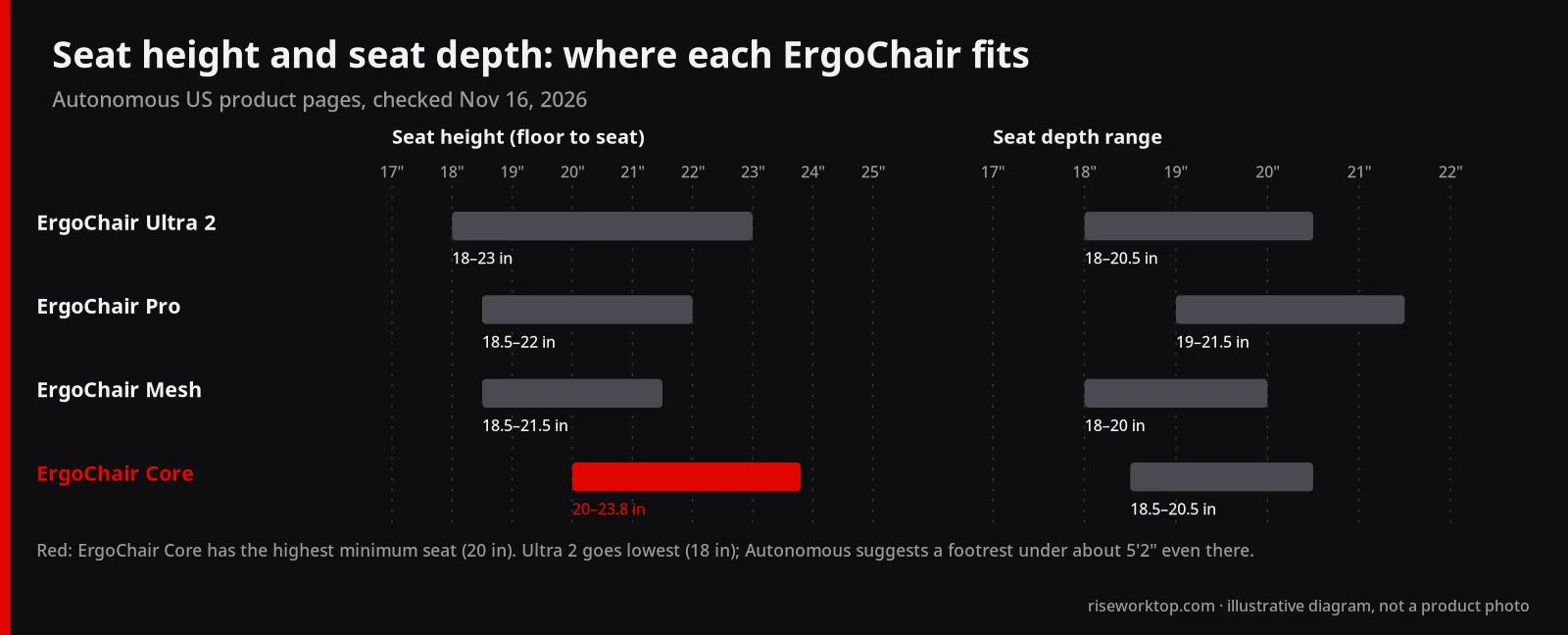
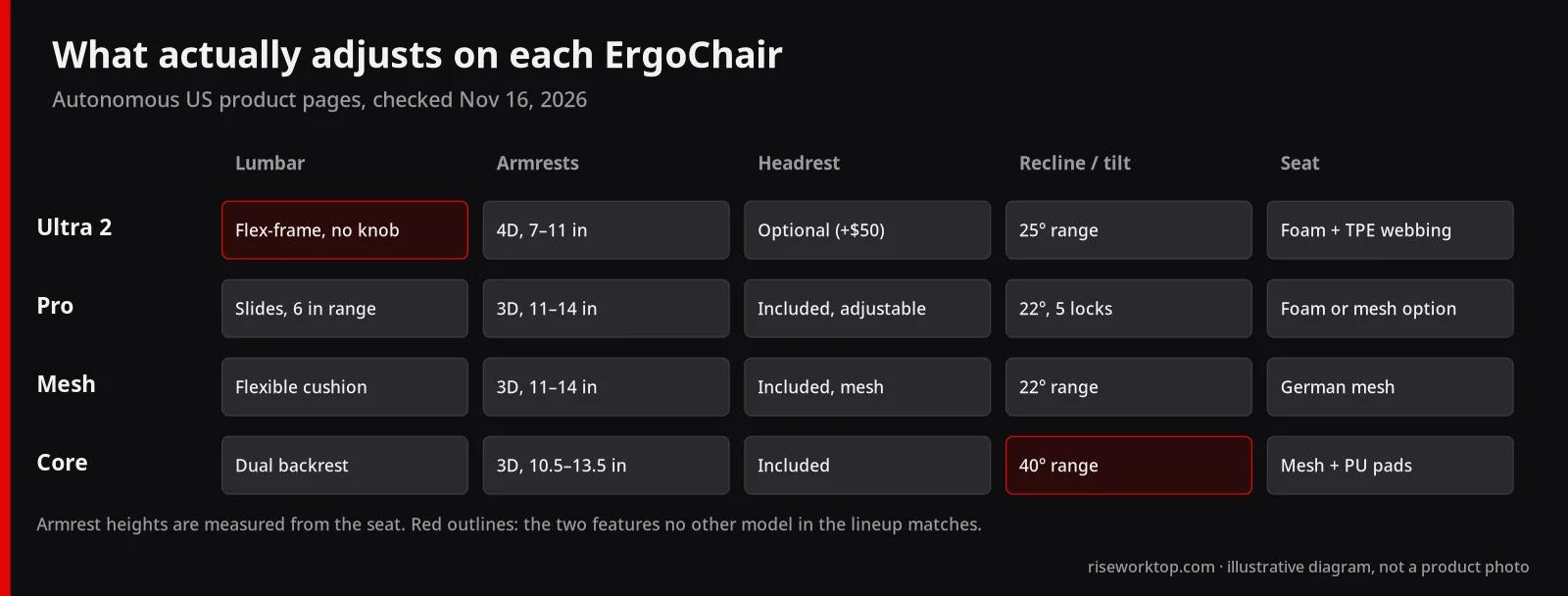
| ErgoChair Ultra 2 | $429 / $449 (with headrest $479 / $499) | 320 lb | 18–23 in | 18–20.5 in | Flex-frame backrest (TPE layer), no lumbar dial | 4D, 7–11 in | Optional | 25° | Lifetime |
| ErgoChair Pro | $469 / $499 | 300 lb | 18.5–22 in | 19–21.5 in | Sliding pad, 6 in height range | 3D, 11–14 in | Included, adjustable | 22°, 5 lock positions | Lifetime |
| ErgoChair Mesh | $469 / $499 | 300 lb | 18.5–21.5 in | 18–20 in | Flexible cushion, height-adjustable | 3D, 11–14 in | Included | 22° | Lifetime |
| ErgoChair Core | $269 / $299 | 242.5 lb | 20–23.8 in | 18.5–20.5 in | Dual backrest | 3D, 10.5–13.5 in | Included | 40° | 2 years |
Item weights, if you are carrying the box upstairs: Ultra 2 36.5 lb, Core 42 lb, Pro and Mesh 48.5 lb each.
ErgoChair Pro is the default
The Pro wins on the boring things that decide whether a chair fits a stranger: it has the longest seat-depth range in the lineup (19 to 21.5 inches), a lumbar pad you can physically move through 6 inches of height, an adjustable headrest in the box, and a lifetime warranty. Autonomous lists nine adjustment points, a synchro-tilt mechanism that reclines the back while the seat stays level, five lock positions, and a tilt mechanism tested to 100,000 cycles. Its own summary page says it fits people up to 6'3".
The trade-off is that the default seat is high-density molded foam, which Autonomous itself describes as firm. There is a cool-mesh seat option on the same page. If you know you like a soft seat, the Pro's spec sheet will not fix that.
I would also not overrate the 22-degree recline. It is enough to lean back on a call. It is not a lounge chair, and the Core's 40-degree range is the one to look at if reclining is a big part of your day.
ErgoChair Ultra 2: the better chair for heavier and shorter people
The Ultra 2 is the most interesting chair here, and for two groups it is simply the right one.
- Over 300 lb: it is the only ErgoChair rated above 300 lb (320 lb), and it uses an aluminum five-star base where the Pro's page lists a nylon frame.
- Shorter users: the seat goes down to 18 inches and the armrests drop to 7 inches above the seat. Autonomous's own FAQ says that under about 5'2" a footrest still helps, since 18 inches is as low as it goes. If you are in that range, add a footrest to the budget; our footrests and mats guide covers the options.
The catch is philosophical. The Ultra 2 has no lumbar dial at all. The support comes from a TPE layer behind the mesh that flexes with your back. That is a better idea if you shift around all day and never set a lumbar pad correctly anyway. It is a worse idea if you already know you need firm support in one exact spot, because there is nothing to move. I can't tell you how that feels on your back, and I would not trust anyone who claims to without knowing your back; this is the chair to buy with the return window in mind.
Also check the headrest. The $429 price is without one. With the headrest it is $479, which is $10 more than the Pro on this sale, so the Ultra 2 is only the cheaper chair if you skip the headrest.
ErgoChair Mesh: hard to recommend over the Pro
On paper the Mesh and the Pro are siblings: same $469 sale price, same 300 lb rating, same 3D armrests, same 22-degree recline, same lifetime warranty and the same 48.5 lb weight. The Mesh uses what Autonomous calls a special German mesh for both seat and back and moves the lumbar with a flexible cushion.
Here is the problem. The Pro also offers a mesh seat option, and it has the longer seat-depth range (19–21.5 inches against 18–20) and the taller maximum seat (22 inches against 21.5). Autonomous's own fit note for the Mesh is 5'0" to 6'2", against up to 6'3" for the Pro. The Mesh is the better pick only if you have short thighs and want the shallower 18-inch depth setting, or you specifically want mesh everywhere because you work in a warm room. For everyone else, it is the Pro with less range.
ErgoChair Core: a fine budget chair, judged as one
The Core is $200 cheaper than the Pro on this sale, and some of its numbers look better: the widest seat (20 inches), the most recline (40 degrees), a headrest included. If you sit upright for a few hours a day and weigh comfortably under its rating, it is a sensible chair.
Judge it by its limits, though:
- 242.5 lb capacity, the lowest here by a wide margin.
- 2-year warranty against lifetime on the other three. If you plan to keep a chair five years or more, that difference alone is worth a good part of the price gap.
- 20-inch minimum seat height, the highest in the lineup. Shorter users who already need a footrest on the 18-inch Ultra 2 will need one here too. Run your numbers through our desk height calculator before you assume it fits under your desk with your feet flat.
- Dual backrest instead of an adjustable lumbar pad. You cannot move the support up or down.
Check the chair against the desk
A chair spec only matters relative to the desk. Two checks, both from numbers you can measure in a minute:
- Armrests under the desk. Add the chair's seat height to its armrest height. The Pro at its lowest seat with its lowest arms puts the armrest tops about 29.5 inches off the floor (18.5 plus 11), which can hit a desk with a low apron or a keyboard tray. The Mesh page lists 26.7–32.2 inches from the floor, and the Core 27.8–30.7. If your desk sits around 28–29 inches, plan to drop or swing the arms. Our keyboard tray guide has the clearance math if you use one.
- A standing desk changes the sitting height, not the chair. If you are pairing a chair with an Autonomous desk, the desk's minimum height is the number to match. Our Autonomous Desk Core vs Desk 2 vs Desk Pro comparison lists every model's range, and the Desk Core's 29.4-inch minimum is the one most likely to fight a tall chair.
On a hard floor, add a mat; on carpet, check the casters. The Ultra 2 has 2.56-inch casters; the Pro, Mesh and Core list 2.36 inches.
FAQ
Which Autonomous ErgoChair should I buy?
For most people, the ErgoChair Pro: movable lumbar, adjustable headrest, the longest seat-depth range and a lifetime warranty at $469 ($499 list) on November 16, 2026. Choose the Ultra 2 if you weigh over 300 lb or need an 18-inch seat, and the Core only on a strict budget.
Is the ErgoChair Ultra 2 better than the ErgoChair Pro?
It is better for heavier users (320 lb vs 300 lb) and shorter users (18-inch minimum seat, 7-inch minimum armrests). The Pro is better if you want a lumbar pad you can place and a headrest without paying extra. Without a headrest the Ultra 2 is $40 cheaper; with one, it is $10 more on the November 16 sale.
Is the ErgoChair Core worth it?
Yes, if your budget is near $300, you weigh well under 242.5 lb and you do not need a lifetime warranty. It reclines the most (40°) and includes a headrest, but its 20-inch minimum seat is the highest in the lineup and its warranty is 2 years.
What is the difference between the ErgoChair Mesh and the ErgoChair Pro?
Same price, capacity, recline and warranty. The Mesh is all mesh with a flexible lumbar cushion and an 18–20-inch seat-depth range; the Pro has a foam seat (mesh optional), a sliding lumbar pad and a 19–21.5-inch depth range. Most people should buy the Pro.
Which ErgoChair has the highest weight capacity?
The Ultra 2, at 320 lb. The Pro and Mesh are rated to 300 lb and the Core to 242.5 lb, per Autonomous's product pages.
Do Autonomous chairs have a lifetime warranty?
The Pro, Ultra 2 and Mesh do; the Core has a 2-year warranty. All four list free 30-day returns, but Autonomous says that policy does not apply to flash-sale items or limited-time deals, so check the terms on a Black Friday order.
Did you test these chairs?
No. This page compares Autonomous's published specs, prices and policies. Nothing here is a comfort or durability test, and the calls are judgments from those numbers.
Bottom line
Buy the ErgoChair Pro unless one of three things is true. Over 300 lb or short enough to need an 18-inch seat: Ultra 2. A hard budget near $300 and comfortably under 242.5 lb: Core, knowing the warranty is 2 years. A warm room and a strong preference for mesh everywhere: Mesh. Check the seat height and armrests against your desk before you order, and confirm return terms on any sale price.
Sources
- Autonomous, ErgoChair Ultra 2, ErgoChair Pro, ErgoChair Mesh and ErgoChair Core product pages, and the chair comparison page, checked November 16, 2026.
- Autonomous, llms.txt product summary (warranty terms by product and the Pro's "fits up to 6'3"" note), checked November 16, 2026.