
We may earn a commission if you buy through links on this page, at no extra cost to you. How we make money
If you already want an Autonomous standing desk, the useful question is not "which one is best." It is which compromise you are actually buying: footprint, height range, motor and warranty, or a corner.
Most people shopping this lineup should start with the Desk 2. The rest of the catalog exists for cases that desk does not cover.
Research note: AI-assisted research and writing, not hands-on tested. Written by Rhett Varley. No desk, chair or frame was set up or tested for this page. Every call below is a judgment from Autonomous's US product pages, checked on November 12, 2026, plus OSHA's Computer Workstations eTool where height is discussed. Prices change often; treat them as "as of Nov 12, 2026," and note that several pages were showing Black Friday sale prices that day. The Autonomous links on this page are affiliate links (we may earn a commission), and nobody paid for placement (how we research).
Quick answer
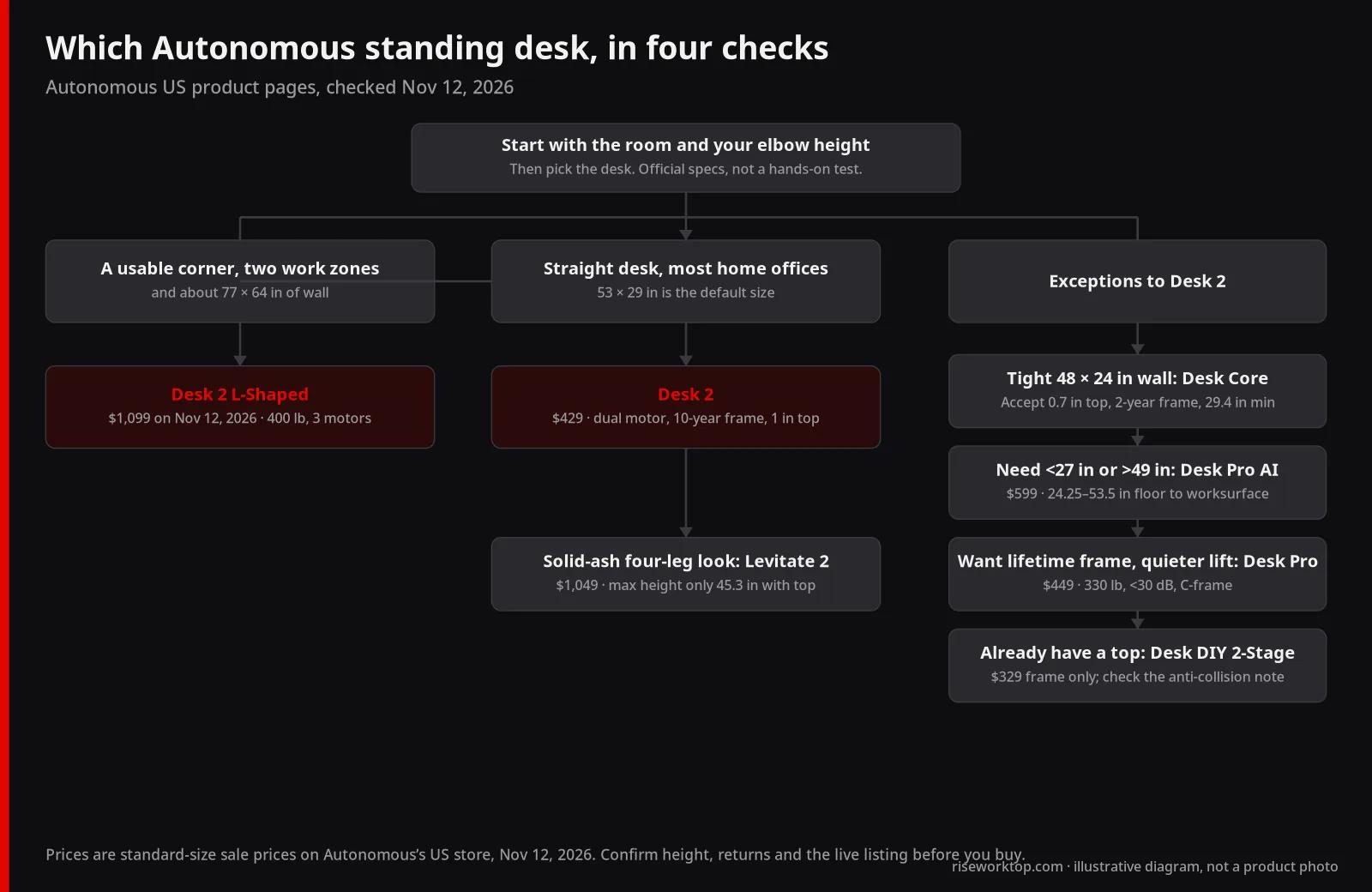
Buy the Desk 2 if you want a complete Autonomous standing desk and your room fits a 53 × 29-inch top: it is the default in this lineup, with a dual motor, a 250 lb rating, anti-collision, a 1-inch top and a 10-year frame warranty, at $429 ($449 list) on November 12, 2026. Choose the Desk Core only when you need the 48 × 24-inch footprint and can live with a single motor, a 0.7-inch top, a 29.4-inch minimum sitting height and a 2-year frame. Choose Desk Pro when the lifetime frame warranty, quieter <30 dB lift and 330 lb rating are worth $20 more than Desk 2 on this sale, and choose Desk Pro AI only if you need the 24.25–53.5-inch floor-to-worksurface range. The Desk 2 L-Shaped (the former DuoSpace) is the corner desk, not a fancier Desk 2.
If you are still choosing among brands, start with our standing desk under $500 guide instead of this page.
Quick comparison
All figures below are from Autonomous's US product pages, checked November 12, 2026, for the standard complete size unless noted. Sale prices were the live checkout prices that day; list prices are the struck-through figures on the same pages. Desk Pro AI had a $599 price and no separate list price in the page's product data.
| Model | Sale / list | Motors | Published height | Standard top | Capacity | Anti-collision | Frame / top warranty |
|---|---|---|---|---|---|---|---|
| Desk Core | $299 / $349 | Single | 29.4–47.5 in with top (28.7–46.8 in without) | 48 × 24 × 0.7 in, MDF / particleboard | 176 lb | Not listed | 2 years / 1 year |
| Desk 2 | $429 / $449 | Dual | 27.2–46.5 in (page does not say whether the 1 in top is included) | 53 × 29 × 1 in MDF (70.5 × 30 in XL also sold) | 250 lb | Yes | 10 years / 2 years |
| Desk Pro | $449 / $499 | Dual | 29.5–48.5 in | 53 × 29 × 1.2 in HDF (70.5 in Expanse also sold) | 330 lb | Yes | Lifetime / 2 years |
| Desk Pro AI | $599 | Dual | 24.25–53.5 in, floor to worksurface | Same chassis as Desk Pro | 450 lb | Yes | Lifetime / 2 years |
| Desk 2 L-Shaped | $1,099 / $1,149 | Triple | 29.4–48 in with top (28.4–47 in without) | 77 × 64 in overall (77 × 29 in main plus 29 × 35 in reversible return), 1 in MDF | 400 lb | Yes | 10 years / 2 years |
| Desk DIY 2-Stage (frame only) | $329 / $349 | Dual | 27.2–46.5 in without a top | You supply the top; 48–80 × 26–32 in recommended | 250 lb | No (on this page) | 10 years / n/a |
| Desk Levitate 2 | $1,049 / $1,099 | Quad | 28–45.3 in with top (26.8–44.1 in without) | 53 × 29 × 1.2 in solid ash (59 × 31.5 in Ultra also sold) | 380 lb | Yes | 10 years / 2 years |
Check your sitting and standing elbow height against those ranges with the desk height calculator before you fall for a sale price. Autonomous's 30-day trial and return policy, printed on these pages, does not apply to flash-sale or limited-time deal items, and several listings were labeled Black Friday when I checked.
Desk 2 is the default
The Desk 2 is the desk Autonomous has been revising in place since 2015, and on paper it is the one I would buy for a typical US home office. Dual motors, 250 lb, anti-collision, four presets, a 53 × 29 × 1-inch MDF top, lift at 1.1 inches per second, noise under 45 dB, and 10 years on the frame with 2 years on the top. ANSI/BIFMA and UL are listed. The standard black or white finish was $429, down from $449, on November 12, 2026. White oak was $479 ($499 list) and bamboo $529 ($549 list); the 70.5 × 30-inch XL was $729 ($749 list).
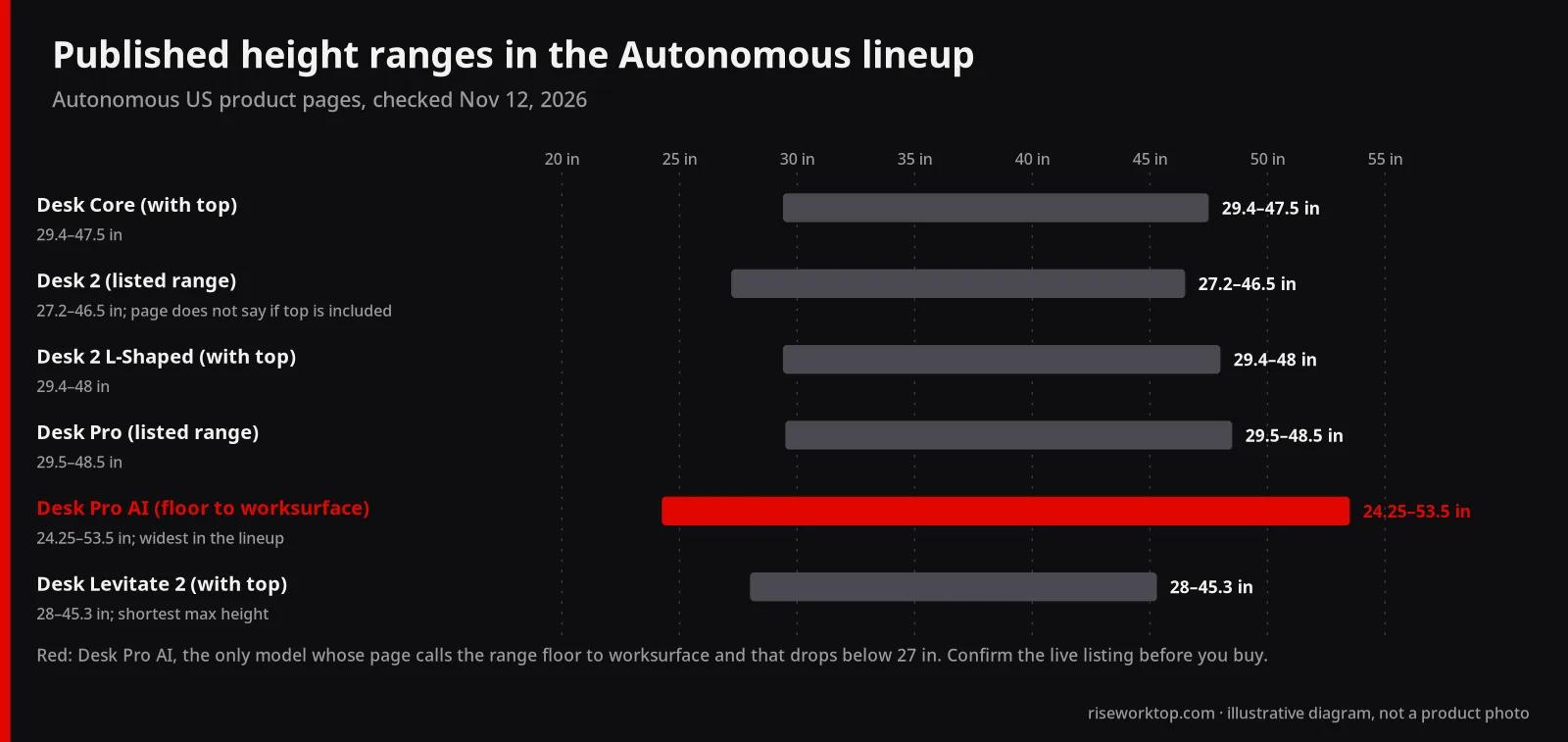
That 29-inch depth is the practical reason to pick it over Desk Core if the wall can take it: our 24 vs 30-inch desk depth guide is built around how quickly dual 27-inch monitors and a keyboard eat a shallower top. The listed height range is 27.2–46.5 inches. The product page does not say whether that includes the 1-inch top. The Desk DIY 2-Stage page, which Autonomous says uses the same frame, lists 27.2–46.5 inches without a top. If you are tall, or you will put a walking pad under the desk, confirm the live listing and measure; our standing desk under $500 guide already flags that 46.5-inch ceiling.
Skip Desk 2 if your wall cannot spare a 53 × 29-inch top, you need a sitting height below the mid-27s or a standing height above the mid-46s, or you have already decided you want a corner cockpit.
Desk Core: only if the 48 × 24-inch top is the point
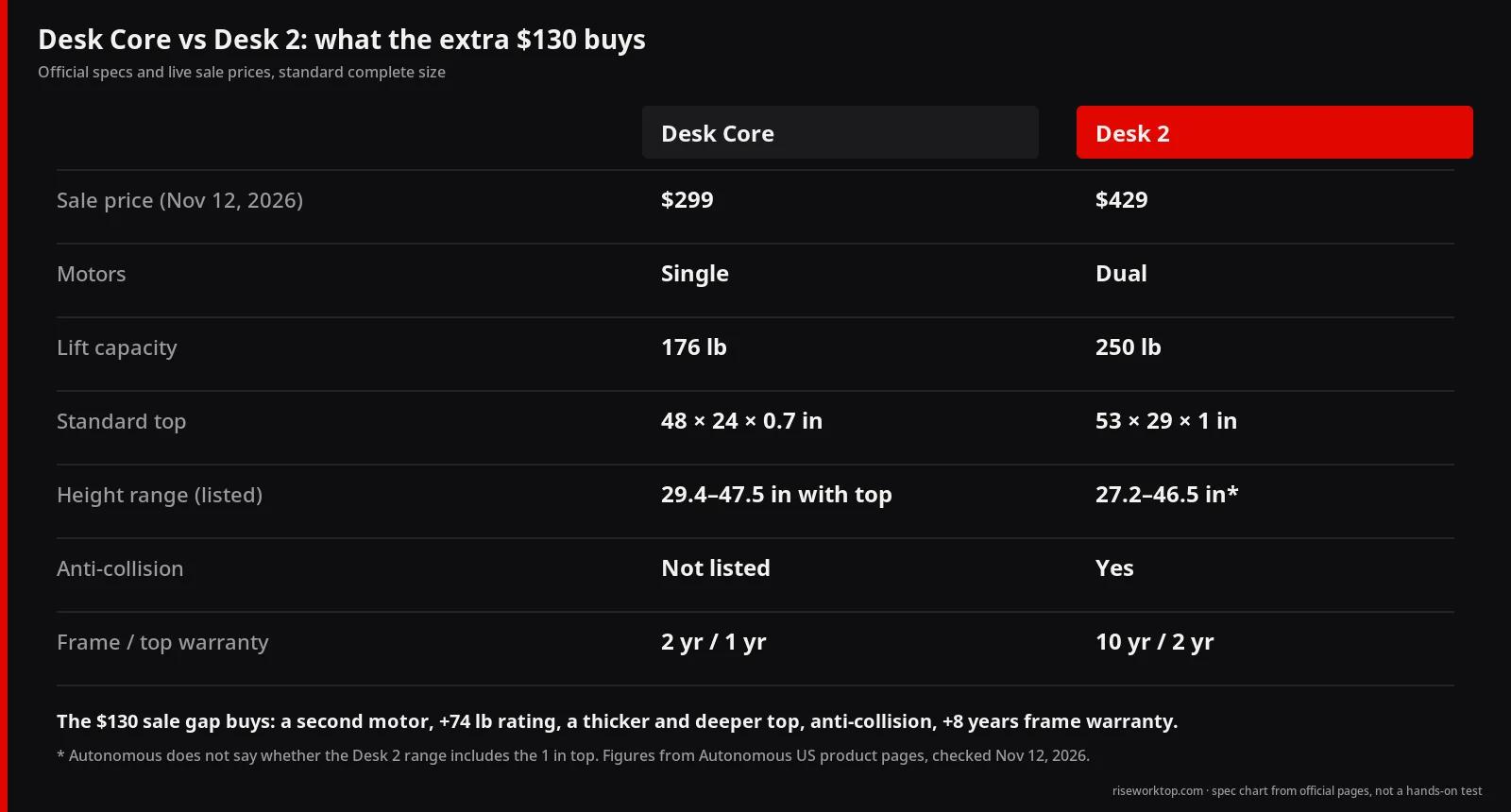
The Desk Core is the small-space desk in this catalog, and it is cheaper for a reason. The official table lists a single motor, 176 lb, 1 inch per second, noise at or under 50 dB, a 48 × 24 × 0.7-inch MDF and particleboard top, one cable tray, and 2 years on the frame with 1 year on the top. Height is 29.4–47.5 inches with the top, 28.7–46.8 inches without. The page does not list anti-collision. It was $299, down from $349, on November 12, 2026.
Two of those numbers should stop a lot of people. First, 29.4 inches is a high minimum for a sitting desk. If your seated elbow height is below about 29 inches, this frame may never get low enough; run the desk height calculator and, if you are in a tight room, also read how to choose a standing desk for a small home office. Second, a 0.7-inch top sits under the clamp minimum on more than one arm in our monitor riser vs monitor arm comparison. A riser does not care about thickness; many clamps do.
Buy Core if the 48 × 24-inch footprint is what the room allows, your sitting height still fits, and you are not hanging a heavy clamp-on arm on that thin top. Otherwise, the $130 sale gap up to Desk 2 is buying a second motor, 74 lb more rating, a 1-inch top, anti-collision and eight extra years on the frame. That is the better spend for most people.
Desk Pro and Desk Pro AI: pay for range or warranty, not the badge
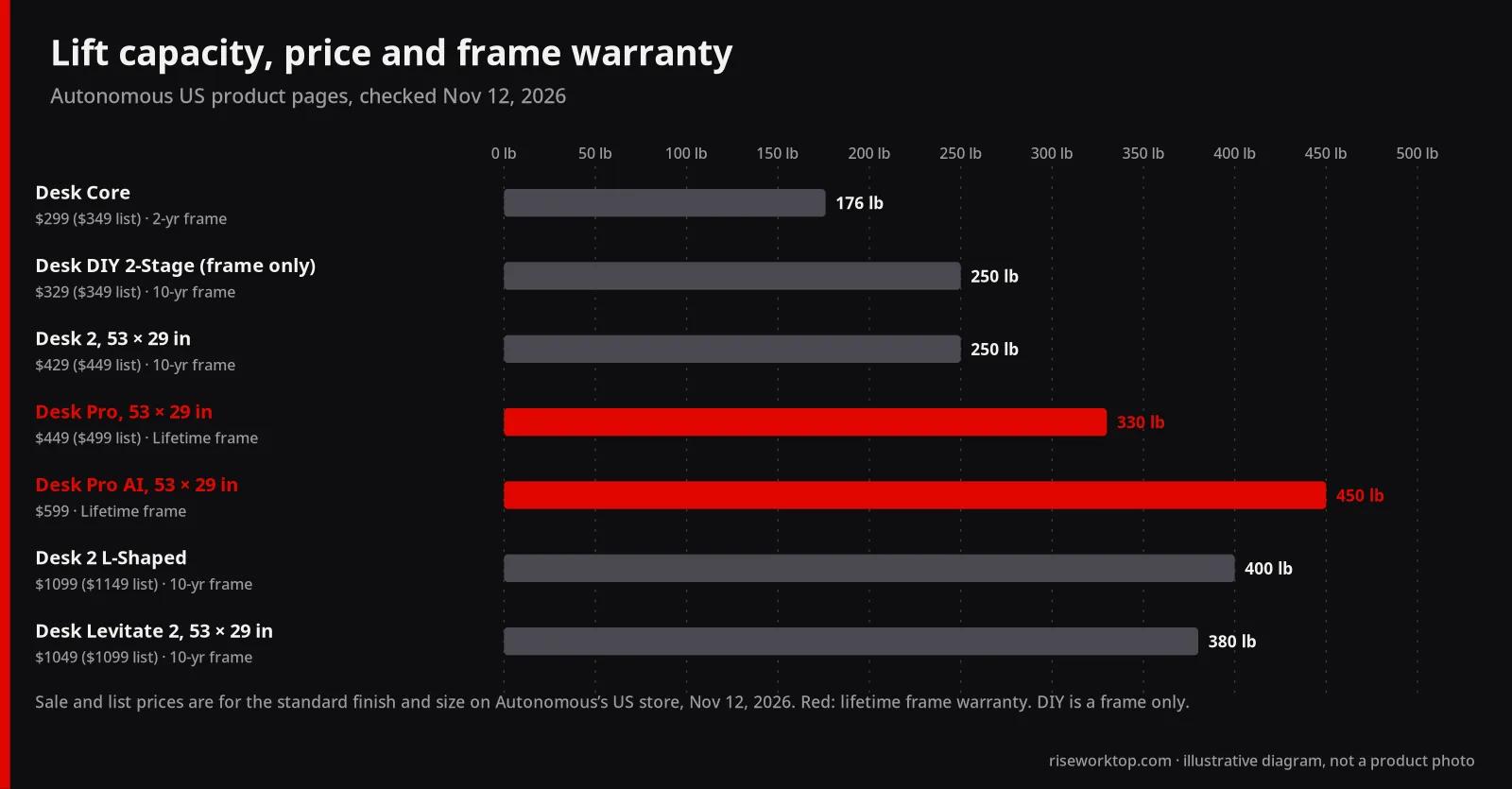
Desk Pro and Desk Pro AI share a product page and a C-frame chassis. Autonomous says the C-shape drops the front crossbar for knee clearance. Both list a dual motor, 1.2 inches per second, noise under 30 dB, anti-collision, a 53 × 29 × 1.2-inch HDF top (or a 70.5-inch Expanse), lifetime coverage on the frame and 2 years on the top. Desk Pro is rated 330 lb with a published height range of 29.5–48.5 inches; it was $449, down from $499, on November 12, 2026. The same size in Pro AI was $599, rated 450 lb, with a floor-to-worksurface range of 24.25–53.5 inches.
Desk Pro also publishes a stability figure the others do not: a TÜV Rheinland report (VN26FTMK 001) of 0.2344 inches of worst-case oscillation at 46 inches of height. I have not reviewed that report beyond the figure on the product page, and I am not treating it as a hands-on wobble test.
On this sale, Desk Pro is only $20 above Desk 2. That $20 is a straightforward trade: lifetime frame warranty, a quieter listed lift, 80 lb more capacity, a thicker top, and a slightly higher maximum. It is not a reason to ignore Desk 2's possibly lower minimum; Pro's listed floor is 29.5 inches, which is in Core territory.
Desk Pro AI is a different call. The $150 step up from Pro (or $170 from Desk 2) is worth it on paper if you need that 24.25–53.5-inch floor-to-worksurface window — notably short or tall users, or anyone who already knows a mid-29-inch sitting floor will not work. The six listed sensors (CO₂, particulates, VOC, NOx, carbon monoxide, on-device sound level, plus presence and distance) and the companion app are extras, not the reason I would spend the money. I have not used the app, and a desk that "reads the room" is still a desk you have to measure first.
The 70.5-inch Pro XL was $799 ($849 list); Pro AI XL was $949.
Desk 2 L-Shaped: the corner desk, not an upgrade
The Desk 2 L-Shaped is the same desk previously sold as Autonomous DuoSpace. If you want the shape-choice argument first, use our L-shaped desk vs straight desk guide, which already walks through this model's footprint. This page only answers whether it belongs in an Autonomous-only shortlist.
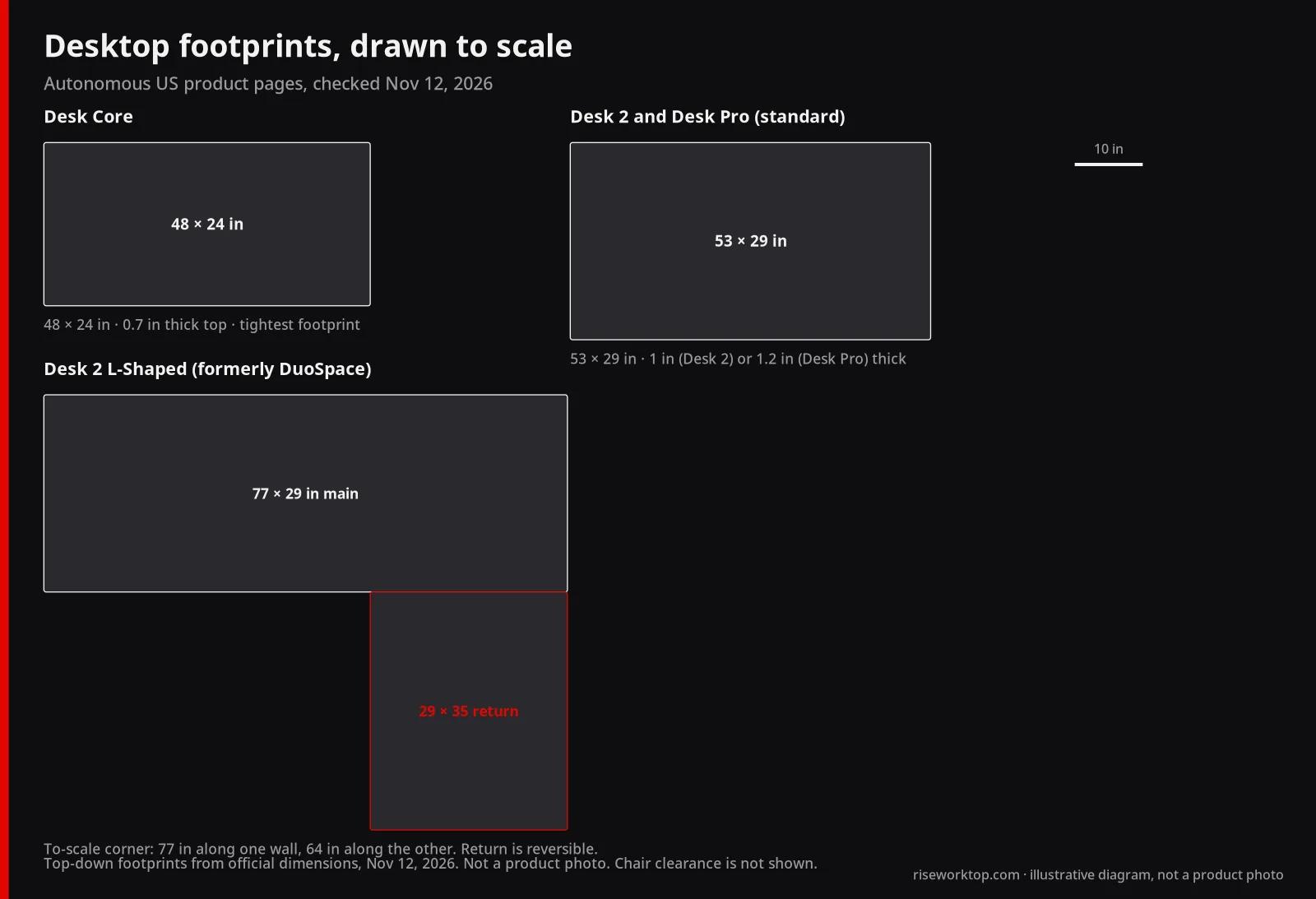
On the official table: three motors, 400 lb, 2.3 inches per second, 50 dB, anti-collision, four presets, a 1-inch MDF top, and 10 years on the frame with 2 years on the top. The full surface is 77 × 64 inches, made of a 77 × 29-inch main top and a 29 × 35-inch reversible return, so one SKU covers a left or right corner. Height is 29.4–48 inches with the top. A cable tray is included. It was $1,099, down from $1,149, on November 12, 2026.
Our call: buy it when you have already measured a corner that can take about 77 inches on one wall and 64 on the other, plus chair clearance, and you actually work across two zones. Do not buy it as a "nicer Desk 2." You are paying about $670 more than Desk 2, on this sale, for a second surface that also rises, not for a better straight desk. Shipping is listed as three boxes totaling about 201 lb; plan for two people, and remember the sale-price return caveat above.
Desk DIY and Desk Levitate 2
The Desk DIY is a frame only. The 2-Stage was $329 ($349 list) on November 12, 2026: dual motor, 250 lb, 1.1 inches per second, 45 dB, 27.2–46.5 inches without a top, 10-year frame, recommended top 48–80 × 26–32 inches. The L-shape frame was $799: triple motor, 400 lb, 28.4–47 inches without a top, cable tray included. Autonomous says these are the frames under Desk 2 and the Desk 2 L-Shaped. One contradiction is worth reading off both pages: Desk 2 lists anti-collision as yes; the DIY 2-Stage table lists anti-collision as no. I am not guessing which is current. If that feature matters, ask Autonomous or wait for the pages to agree. A matching 53 × 29 × 1-inch Desk Surface was $149 in white or black, which makes a DIY-plus-top bundle $478 at those sale prices — more than a complete Desk 2.
The Desk Levitate 2 is the furniture-grade option: four legs, four motors, a 1.2-inch solid-ash top, 380 lb, 1.25 inches per second, noise under 45 dB, anti-collision, enclosed cable routing with two power outlets and USB-C, and 10 years on the frame with 2 years on the top. The standard 53 × 29-inch size was $1,049, down from $1,099. The catch is the height band: 28–45.3 inches with the top, the shortest maximum in this lineup. If you are tall, or you want a walking-pad standing height, this is the wrong expensive desk. Buy it for the solid-ash, no-crossbar look, not for range.
Measure the room, then the height
The table above does not replace a tape measure. For a small apartment wall, start with the small-space standing desk guide. For dual monitors, check depth, not just width, in the 24 vs 30-inch desk depth guide. Then put your stature into the desk height calculator, which uses published ANSUR II rows checked against OSHA's keyboard-height ranges, and compare the result with each model's published minimum and maximum. I am not going to invent a "fits a 6-foot user" claim from a brochure.
If you do not need a full electric desk, the cheaper try-standing path is still a converter or a well-chosen fixed desk; that split is in sit-stand converter vs standing desk. Cable slack still matters on every motorized frame: see cable management for standing desks.
A chair, if you are building the same setup
This is a desk comparison, not a chair test. If you are ordering a chair from the same brand, Autonomous listed the ErgoChair Core at $269 ($299 list) on November 12, 2026, with a 2-year warranty. For what to look for under $400, including other brands, use the ergonomic office chair under $400 guide. To choose among all four Autonomous chairs, see our ErgoChair Pro vs Ultra 2 vs Mesh vs Core comparison.
FAQ
Which Autonomous standing desk should I buy?
For a typical straight home-office desk, the Desk 2. Move to Desk Core only for a 48 × 24-inch wall, to Desk Pro if the lifetime frame warranty and quieter lift are worth the small step up on this sale, to Desk Pro AI if you need the 24.25–53.5-inch height range, and to the Desk 2 L-Shaped only if you have a measured corner and two work zones.
Is the Autonomous Desk Core good enough?
It can be, if the small top is the constraint and your sitting height still fits under a 29.4-inch minimum. You are accepting a single motor, a 176 lb rating, a 0.7-inch top and a 2-year frame. That is a different product from Desk 2, not a slightly smaller version of it.
Is Desk Pro worth $20 more than Desk 2 right now?
On the November 12, 2026 sale prices, $20 buys a lifetime frame warranty, a <30 dB listed lift, 330 lb instead of 250 lb, and a 1.2-inch top. That is a reasonable upgrade if those items matter to you and Pro's 29.5-inch listed minimum still fits. It is not a substitute for checking height.
Do I need Desk Pro AI?
Only if you need the published 24.25–53.5-inch floor-to-worksurface range, or you already wanted the listed sensors in the desk. I would not pay $150 over Desk Pro for the "AI" label alone; I have not used the app.
Is DuoSpace different from the Desk 2 L-Shaped?
No. Autonomous now lists that corner desk as the Desk 2 L-Shaped; DuoSpace is the earlier name. Same product page, same 77 × 64-inch two-piece top.
Will the Desk Core work with a monitor arm?
Maybe, but check the clamp. The Core top is 0.7 inch thick, which is below the minimum on some arms we have compared. A riser does not have that problem. See monitor riser vs monitor arm.
Does Autonomous's 30-day trial apply to these Black Friday prices?
Not necessarily. The product pages say the trial and return policy does not apply to flash-sale or limited-time deal items, and several desks were tagged Black Friday when I checked on November 12, 2026. Read the live listing before you pay.
Should I buy the Desk DIY frame and add my own top?
Yes if you already have a suitable top, or you want a size or material Autonomous does not sell. A new official 53 × 29-inch Desk Surface plus the 2-Stage frame was more expensive, at the prices I saw, than a complete Desk 2. Also read the anti-collision mismatch between the Desk 2 and DIY 2-Stage pages.
Which Autonomous desk is best for a tall or short user?
Desk Pro AI is the only model whose page states a 24.25–53.5-inch floor-to-worksurface range. Desk Core, Desk Pro and the L-Shaped all sit at or above 29.4 inches with their tops. Desk Levitate 2 tops out at 45.3 inches with its top, the lowest ceiling here. Confirm your elbow height with the desk height calculator. If you are 6'4" or taller and still comparing brands, our standing desks for tall people guide lines up maximum heights across Autonomous, FlexiSpot and Branch.
Bottom line
Most people in this catalog should buy the Desk 2. Use Desk Core only when 48 × 24 inches is the room, Desk Pro when the lifetime frame and quieter lift are the point, Desk Pro AI when the height range is the point, and the Desk 2 L-Shaped when a measured corner actually needs two rising surfaces. Measure sitting and standing height first, and do not assume a Black Friday price still includes the 30-day trial.
Sources
- Autonomous, Desk Core, Desk 2, Desk 2 L-Shaped, Desk Pro / Desk Pro AI, Desk DIY, Desk Levitate 2, Desk Surface and ErgoChair Core product pages, checked November 12, 2026.
- OSHA, Computer Workstations eTool (keyboard and desk-height ranges used by our calculator).