
We may earn a commission if you buy through links on this page, at no extra cost to you. How we make money
If you are 6'4" or taller, most standing desks on a "best of" list will run out of height before your elbows do, and the one I would buy is the Autonomous Desk Pro AI, because it is the only desk here whose published range (up to 53.5 inches, floor to worksurface) clears a 7-foot person without a disputed spec.
That is a strong call, so here is the short version of why. Tall buyers do not have a capacity problem or a motor problem. They have one number: the maximum height with the desktop on. Everything else in this guide is about reading that number honestly, because brands print it three different ways.
Research note: AI-assisted research and writing, not hands-on tested. Written by Rhett Varley. No desk was assembled, raised or stood at for this page. Every call below is a judgment from manufacturer product pages (Autonomous, FlexiSpot, Branch and VIVO), checked on November 19, 2026, plus the ANSUR II body-size rows used in our desk height calculator. Prices change often; treat them as "as of Nov 19, 2026." Autonomous, FlexiSpot and Branch were all running Black Friday or year-end sale prices that day, and Autonomous says its 30-day trial does not apply to flash-sale or limited-time deal items. The Autonomous links on this page are affiliate links (we may earn a commission); the FlexiSpot, Branch and VIVO links are not, and nobody paid for placement (how we research).
Quick answer
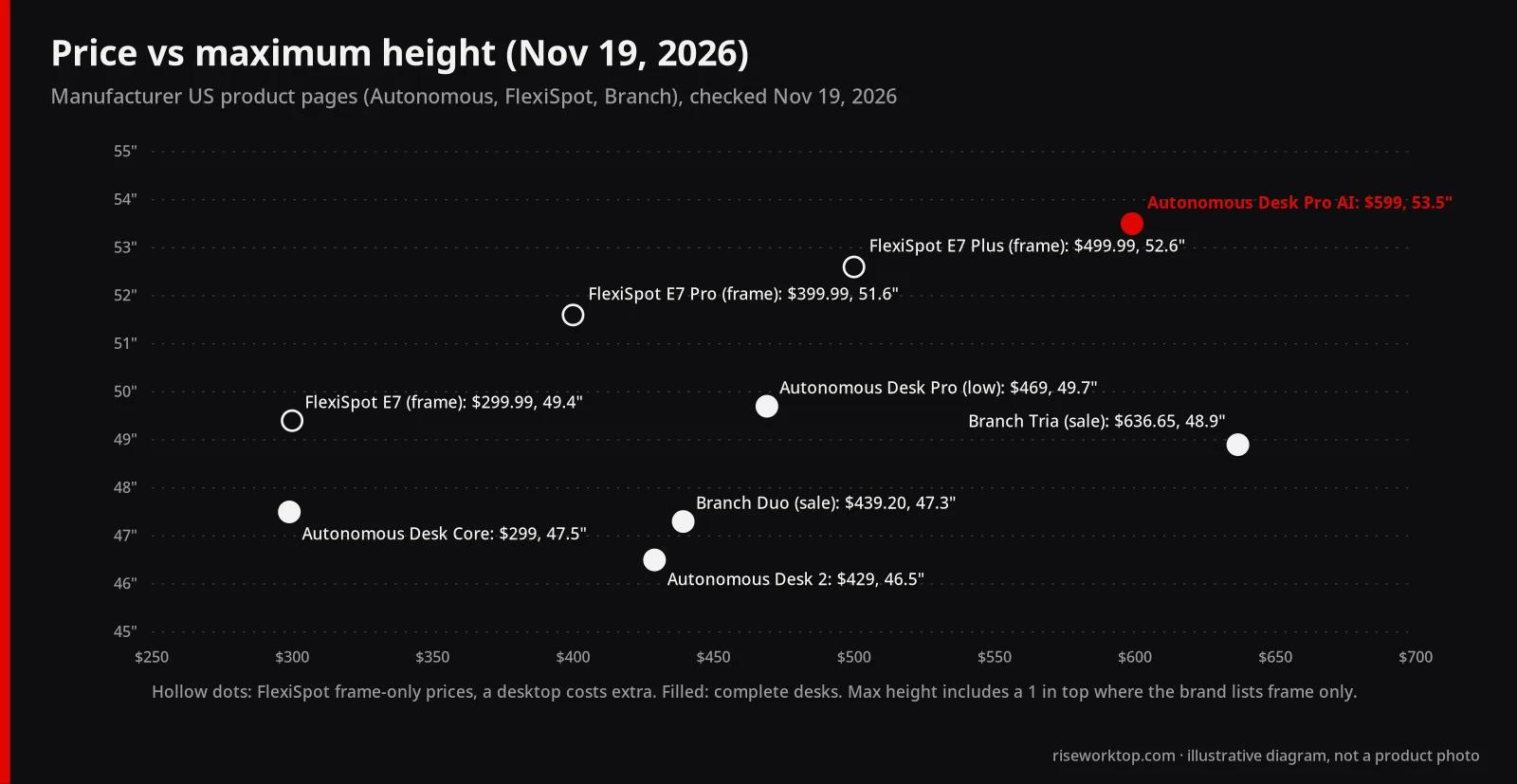
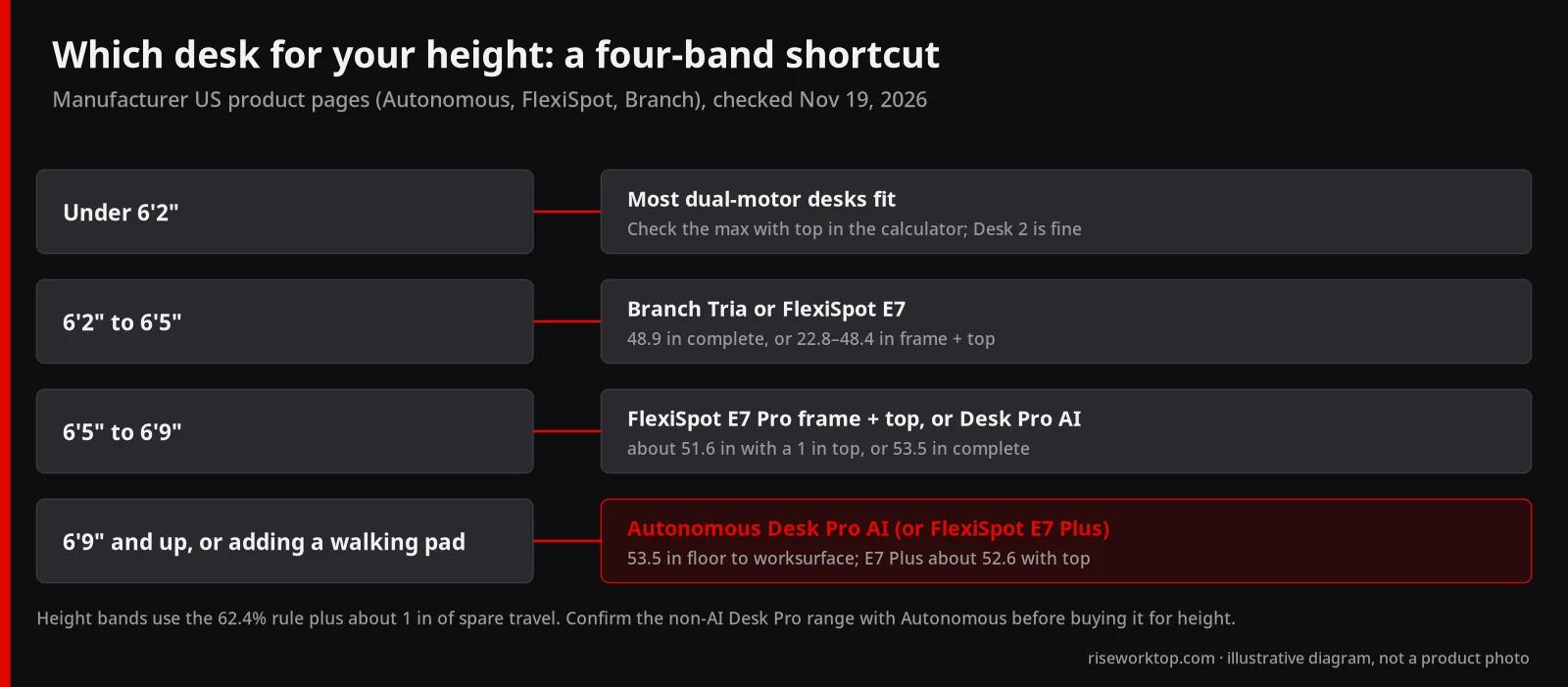
At 6'5" and up, buy the Autonomous Desk Pro AI: 24.25–53.5 inches floor to worksurface, a 450 lb rating, dual motors and a lifetime frame warranty for $599 complete on November 19, 2026. If you would rather spend less and add your own top, the FlexiSpot E7 Pro frame reaches 50.6 inches before the top ($399.99 frame-only, $499.99 list), which is enough to about 6'10" on my math, and the four-leg FlexiSpot E7 Plus reaches 51.6 inches ($499.99 frame-only, $599.99 list). Between 6'3" and 6'6", the Branch Tria (25.5–48.9 in, $636.65 on sale, $749 list) is the better-looking complete desk. Skip anything that tops out under about 47.5 inches with its top, which includes the Autonomous Desk 2, Desk Levitate 2 and Branch Four Leg Standing Desk.
Not sure you are in "tall" territory? Put your height into the desk height calculator first. If your standing desk height comes out under about 46 inches, almost any dual-motor desk works and our standing desk buying guide is the better place to start.
How high does your desk need to go?
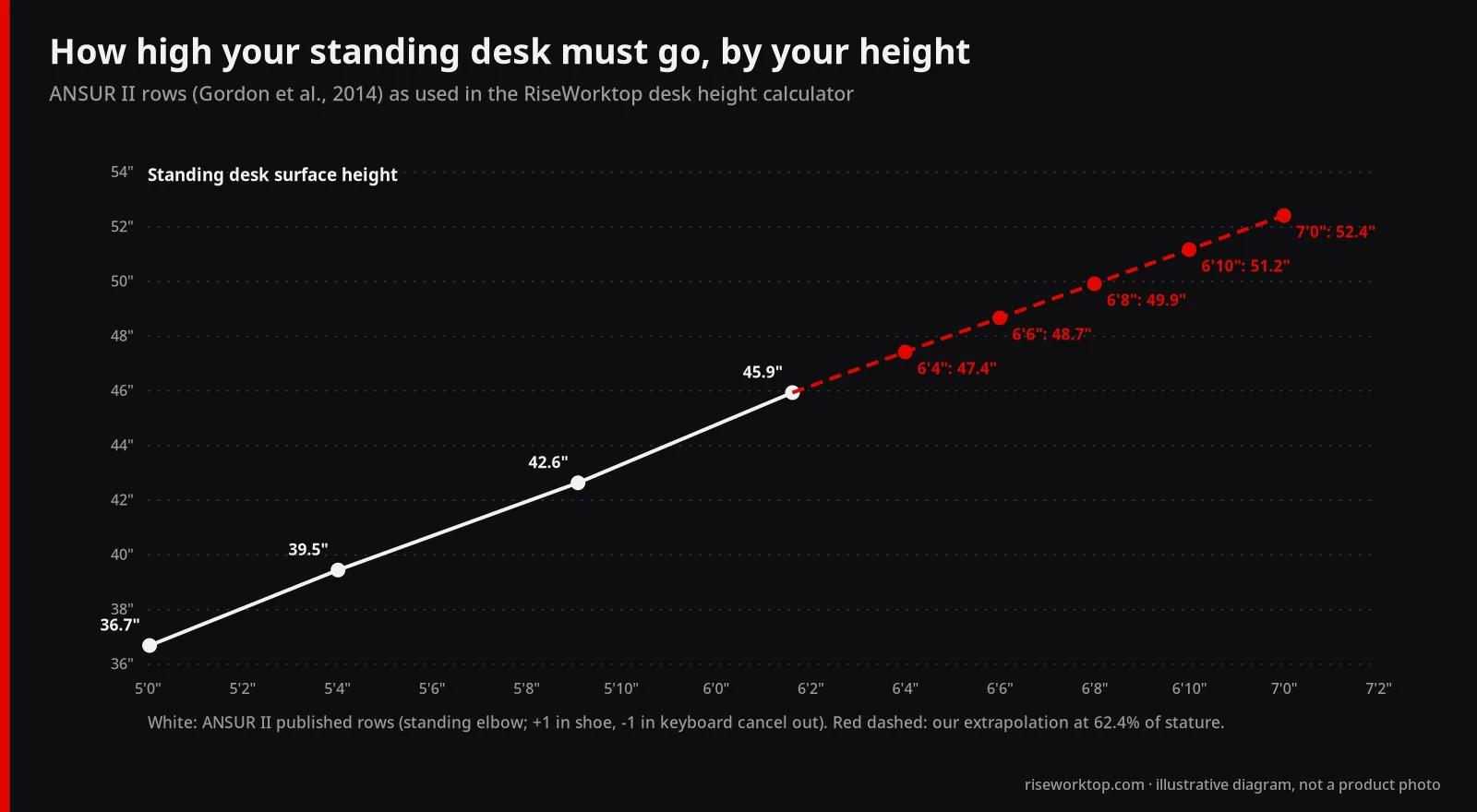
The honest answer comes from one body measurement: standing elbow height. In the ANSUR II survey rows our calculator uses, a 95th-percentile man is 73.62 inches tall (about 6'1.6") with a standing elbow height of 45.94 inches, barefoot. Add an inch for shoes and subtract an inch for a typical keyboard, and the desk surface should sit at about 45.9 inches when he stands.
Above that row there is no published data in our set, so I scaled it. At 45.94 / 73.62, standing elbow height is about 62.4% of stature. That ratio is an extrapolation, not a measurement, and your arms may disagree with it by an inch either way. As a planning number it gives:
- 6'2" (74 in): about 46.2 in
- 6'4" (76 in): about 47.4 in
- 6'6" (78 in): about 48.7 in
- 6'8" (80 in): about 49.9 in
- 6'10" (82 in): about 51.2 in
- 7'0" (84 in): about 52.4 in
I would add one more rule: leave at least an inch of spare travel. A desk at the very top of its range is where every frame is least stable, and you will want room to raise it for thicker shoes, an anti-fatigue mat or a walking pad later.
Sitting is rarely the tall person's problem. The 95th-percentile row puts the sitting keyboard at 30.0 inches, so the desk surface should drop to about 29 inches. Every desk below goes to 29.4 inches or lower except the non-AI Autonomous Desk Pro on its older spec (30.7 inches with the top), which is about 1.7 inches too high for that row.
Maximum height, compared
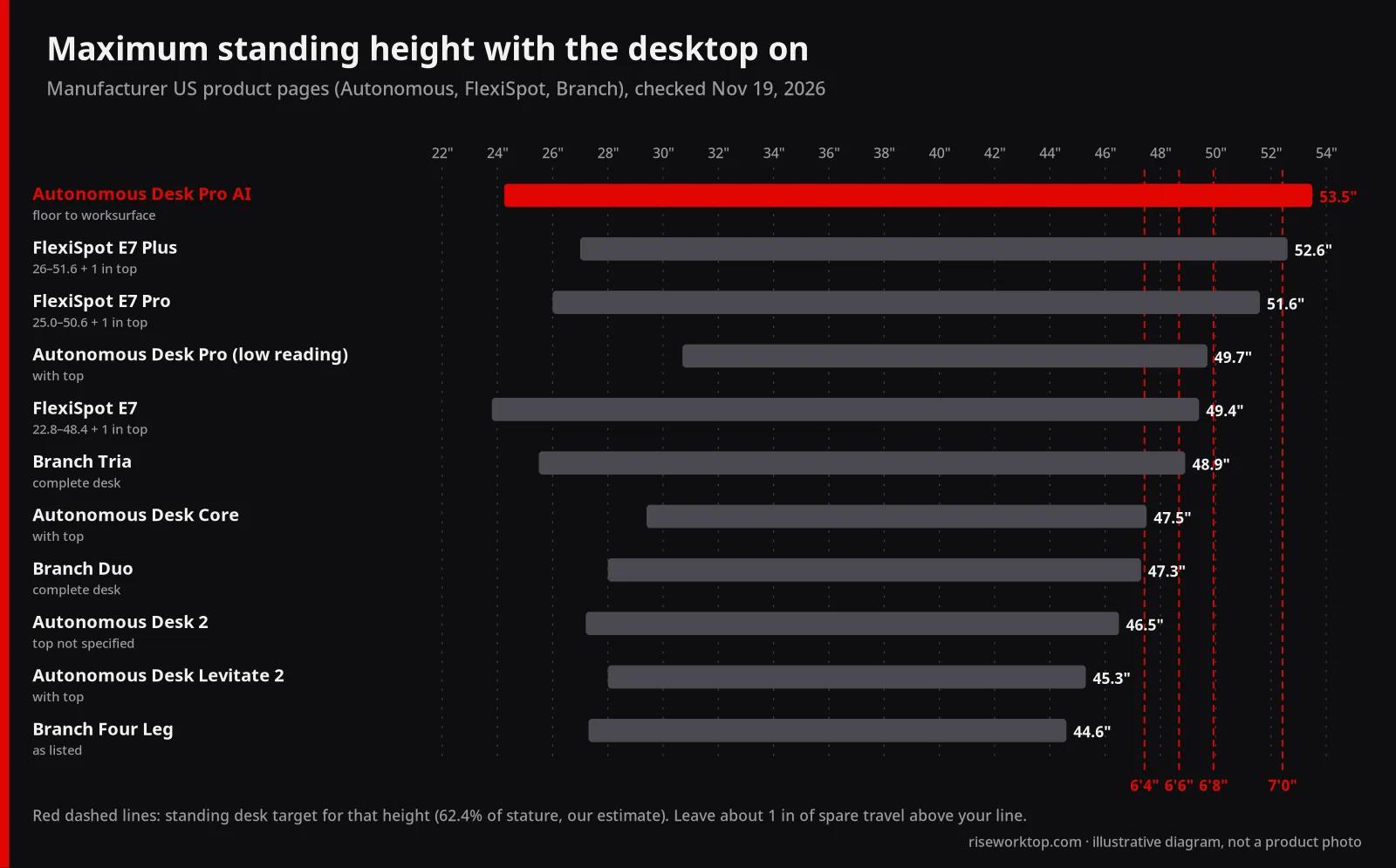
This is the table to screenshot. "Max with top" adds a 1-inch top to frame-only figures so every row is comparable; where the brand already includes the top, I say so. "Fits to about" is the tallest user whose standing target equals that maximum on the 62.4% rule, with no spare travel; take an inch or two off for comfort.
| Desk | Price, Nov 19, 2026 | Published height | Max with top | Fits to about | Legs / motors | Capacity | Frame warranty |
|---|---|---|---|---|---|---|---|
| Autonomous Desk Pro AI | $599 complete | 24.25–53.5 in, floor to worksurface | 53.5 in | 7'1" | 2-leg C-frame, dual | 450 lb | Lifetime |
| FlexiSpot E7 Plus | $499.99 frame ($599.99 list) | 26–51.6 in, without top | ~52.6 in | 7'0" | 4-leg, dual | 440 lb lifting / 540 lb static | 15 years |
| FlexiSpot E7 Pro | $399.99 frame ($499.99 list) | 25.0–50.6 in, without top | ~51.6 in | 6'10" | 2-leg semi-C, dual | 396 lb lifting / 573 lb static | 15 years |
| Autonomous Desk Pro | $469 complete ($499 list) | Disputed: 29.5–48.5 in without top in Autonomous's own summary; 24.25–53.5 in on the shared spec block | 49.7 in (low reading) | 6'7" (low reading) | 2-leg C-frame, dual | 330 lb or 450 lb (same dispute) | Lifetime |
| FlexiSpot E7 | From $299.99 ($349.99 list) | 22.8–48.4 in, without top | ~49.4 in | 6'7" | 2-leg T-frame, dual | 352 lb lifting / 440 lb static | 15 years |
| Branch Tria | $636.65 sale ($749 list) | 25.5–48.9 in, complete desk | 48.9 in | 6'6" | 2-leg, dual | 275 lb | 10 years |
| Autonomous Desk Core | $299 ($349 list) | 29.4–47.5 in with top | 47.5 in | 6'4" | 2-leg, single | 176 lb | 2 years |
| Branch Duo | $439.20 sale ($549 list) | 28–47.3 in, complete desk | 47.3 in | 6'3" | 2-leg, dual | 275 lb | 10 years |
| Autonomous Desk 2 | $429 ($449 list) | 27.2–46.5 in (top not specified) | 46.5–47.5 in | 6'2"–6'4" | 2-leg, dual | 250 lb | 10 years |
| Autonomous Desk Levitate 2 | $1,049 ($1,099 list) | 28–45.3 in with top | 45.3 in | 6'0" | 4-leg, quad | 380 lb | 10 years |
| Branch Four Leg Standing Desk | $854.10 sale ($949 list) | 27.3–44.6 in | 44.6 in | 5'11" | 4-leg, quad | 225 lb lifting / 450 lb static | 10 years |
FlexiSpot prices are the starting prices on its US homepage on November 19, 2026; the E7 Pro and E7 Plus frame pages show the same figures, so budget separately for a desktop. FlexiSpot's E7 and E7 Pro pages quote other capacity figures in their marketing copy; I used the spec blocks. Branch prices are the sale prices shown on the product pages for the smallest size.
Autonomous Desk Pro AI: the safe pick for very tall people
The Desk Pro AI wins on the one number that matters here. Autonomous lists 24.25 to 53.5 inches floor to worksurface, which is 29.25 inches of travel and the only figure in this guide that already includes the top. At 6'8" my target is about 49.9 inches, so the Pro AI still has more than three inches in hand; at 7 feet it has about one.
The rest of the spec sheet supports it rather than carries it: dual motors in a C-frame (no front crossbar under your knees, which matters more for long thighs), a 450 lb rating, lift under 30 dB at 1.2 inches per second, a 53 × 29 × 1.2-inch HDF top, and a lifetime frame warranty with 2 years on the top. Autonomous also publishes a TÜV Rheinland stability report for the Desk Pro chassis: 0.2344 inches of worst-case oscillation at 46 inches. That is measured at 46 inches, not 53, so treat it as a floor on how much it moves for a tall user, not a promise.
The catch is that you are paying $130 over the Desk Pro on this sale for six air-quality sensors you may not want. I would pay it anyway if I were 6'5" or more, and here is why.
Why I would not buy the cheaper Desk Pro for height
Autonomous's own pages disagree about the non-AI Desk Pro. The product page's main spec block, which sits under both models, says 24.25–53.5 inches and 450 lb, and the model picker labels the Pro "C-frame, dual motor, 450 lbs." But Autonomous's own summary file (llms.txt, updated September 2026) says the Desk Pro is 330 lb with a 29.5–48.5-inch range and that the "wider height range" belongs to the Pro AI, and an older spec table still embedded in the same page lists 29.5–48.5 inches without the top and 30.7–49.7 inches with it. When I compared this lineup on November 12, the page itself showed the split too.
If the low reading is right, the $469 Desk Pro reaches 49.7 inches with its top, which covers you to roughly 6'6" with an inch spare. That is fine for many tall people. It is not fine for a 6'8" buyer who ordered it for 53.5 inches. Until Autonomous publishes one number, I would ask support to confirm in writing before buying the non-AI Pro for height. Our Autonomous Desk Core vs Desk 2 vs Desk Pro comparison covers the rest of that lineup.
FlexiSpot E7 Pro and E7 Plus: more reach per dollar, with a top to buy
FlexiSpot quotes heights without the desktop, which flatters nobody but is easy to correct: add your top's thickness. With a 1-inch top, the E7 Pro reaches about 51.6 inches and the four-leg E7 Plus about 52.6. Both clear my 6'10" target on paper.
- E7 Pro ($399.99 frame, $499.99 list): a semi-C frame with the legs set toward the back for knee room, 396 lb lifting and 573 lb static, 4 presets, anti-collision, and 15 years on the frame, motor and electronics. The minimum is 25 inches before the top, so very tall people lose nothing at the bottom.
- E7 Plus ($499.99 frame, $599.99 list): four legs on three-stage columns, 26 to 51.6 inches before the top, 440 lb lifting and 540 lb static. FlexiSpot says the three-stage legs add 53 lb of frame weight for stability; the frame weighs 2 × 48.5 lb. It wants a top at least 0.7 inch thick and 27.6 to 35.4 inches deep, so a shallow 24-inch top is out.
My trade-off call: the E7 Pro is the value pick for anyone up to about 6'9" who is happy sourcing a top. The E7 Plus only makes sense if you specifically want four legs at full height, because its extra inch of reach costs $100 more. Both are frames, so the real total is the frame plus whatever top you choose, and FlexiSpot's 2-year chipboard top warranty is shorter than its frame warranty. FlexiSpot also sells a shorter E7 Plus Fit frame (24 to 45.7 inches); do not order that one by mistake.
The plain E7 (22.8–48.4 inches before the top, from $299.99) is the budget answer up to about 6'6", and the lowest-going desk here if two people of very different heights share it.
Branch Tria: a good-looking desk that stops around 6'6"
Branch's Tria is the most furniture-like desk in this guide and the right one for a 6'3" to 6'6" buyer who wants a complete desk in one box. Branch lists a 25.5 to 48.9-inch lift range (23 inches of travel), 275 lb lifting, two presets, collision detection, a USB-C port on the keypad, Bluetooth for its app, and a 10-year warranty. It was $636.65 against a $749 list price on November 19 in the smallest 48 × 27-inch size.
The limit is the 48.9-inch maximum. On my math that is a 6'6" person at full extension with no spare travel, so I would draw the line at about 6'5". Two presets is also stingy next to four on the FlexiSpot keypads, but most people use two anyway.
Branch's Duo (28–47.3 inches, $439.20 sale) and Four Leg Standing Desk (27.3–44.6 inches, $854.10 sale) are not tall-person desks. The Four Leg in particular tops out lower than a 6-foot person's standing target.
Desks that look tall-friendly and are not
- Autonomous Desk 2 (27.2–46.5 inches). A good default desk, but its 46.5-inch maximum is about a 6'2" target, and the page does not say whether that includes the 1-inch top. If you are over 6'2", do not buy it for yourself.
- Autonomous Desk Levitate 2 (28–45.3 inches with top). Four legs and solid ash at $1,049, and the second-lowest maximum here. Beautiful, but it is a 6-foot desk.
- Autonomous Desk Core (29.4–47.5 inches with top). Reaches a 6'4" target with nothing spare, on a single motor, a 176 lb rating and a 0.7-inch top. Fine at 6'2", tight at 6'4".
- VIVO standing desks. I wanted to include one. VIVO's E2-series listings print a 29.3 to 47.5-inch range, but the same descriptions repeat copy from a different single-motor model, so I could not trust them for a tall-buyer call. Check with VIVO before you rely on any VIVO desk above 6'3".
What a height spec will not fix
Your monitor. A tall person at a correctly set desk still needs the top of the screen near eye level, and a long torso puts that well above where most monitors' own stands stop. A spring arm such as VIVO's STAND-V001O ($39.99 in black) moves the screen center 6.25 to 16 inches above the desk for 4.4 to 19.8 lb monitors, which is the kind of range you need. Our monitor riser vs monitor arm guide has the clamp checks, including the Desk Core's thin top.
Your chair. Long legs need a higher seat. The 95th-percentile popliteal height is 18.54 inches barefoot, so a seat that tops out near 22 inches is fine, but a seat that cannot reach 20 leaves your knees high. Autonomous's ErgoChair Core has the highest range in its lineup (20–23.8 inches) and the ErgoChair Ultra 2 goes to 23; see our ErgoChair comparison for the trade-offs.
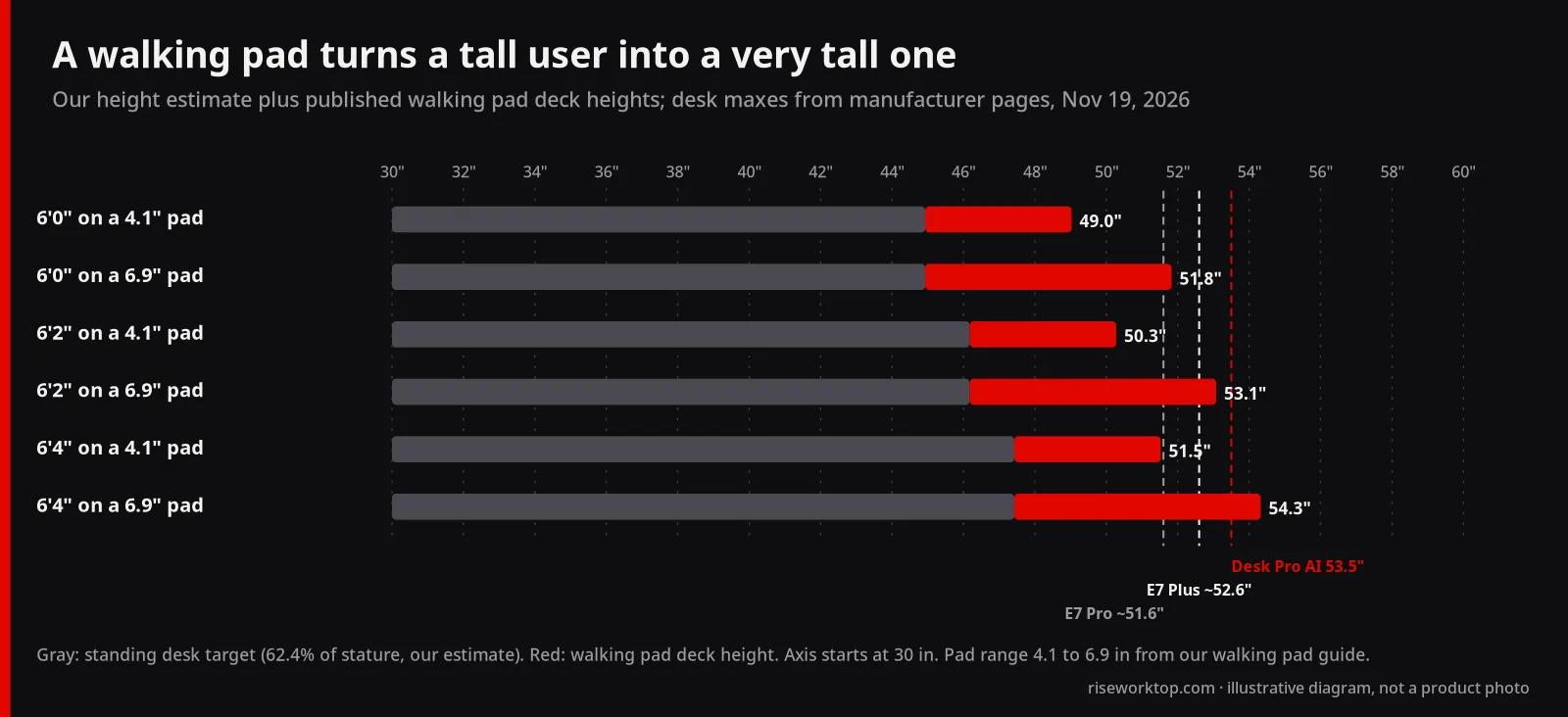
A walking pad. A pad adds 4 to 7 inches under your feet, and the desk has to rise by the same amount. At 6'2" plus a 6-inch pad you need about 52 inches, roughly a 7-foot person's target, which only the Desk Pro AI and E7 Plus reach on paper. Our standing desk for a walking pad checklist does that math.
Wobble at full height. Every frame moves more the higher it goes. If you sit at the very top of a range all day, expect more sway than the reviews written by average-height people describe. That is the real reason for the one-inch-spare rule.
FAQ
What is the best standing desk for tall people?
On published specs, the Autonomous Desk Pro AI: it reaches 53.5 inches floor to worksurface, the highest top-included figure I found, for $599 on November 19, 2026. On a budget, the FlexiSpot E7 Pro frame reaches 50.6 inches before the top for $399.99, plus a desktop.
How tall should a standing desk be for a 6'4" person?
About 47.4 inches at the desk surface, using a 62.4% elbow-to-height ratio from ANSUR II rows with an inch of shoe and an inch of keyboard. Look for a desk whose maximum with its top is at least 48.5 inches so you have spare travel.
How tall should a standing desk be for a 6'6" person?
About 48.7 inches. The Branch Tria (48.9 inches) is right at its limit; the FlexiSpot E7 Pro, E7 Plus and Autonomous Desk Pro AI have room to spare.
Is the Autonomous Desk Pro tall enough for a 6'5" person?
Probably, but check. Autonomous's summary lists the non-AI Desk Pro at 29.5–48.5 inches without the top (about 49.7 with it), which covers about 6'7" at full extension. Its product page also shows a 53.5-inch figure that Autonomous elsewhere attributes to the Pro AI. Confirm with Autonomous before relying on the higher number.
Do FlexiSpot heights include the desktop?
No. FlexiSpot lists the E7, E7 Pro and E7 Plus heights without a top, so add your desktop thickness (about an inch on a typical top). Autonomous's Desk Pro AI figure is floor to worksurface, and Branch lists complete-desk ranges.
Are four-leg desks better for tall people?
Not automatically. FlexiSpot's E7 Plus is four-legged and tall, but Autonomous's Levitate 2 and Branch's Four Leg Standing Desk are four-legged and among the lowest desks here. Check the maximum height first.
Did you test these desks?
No. This page compares published specs, prices and body-size data. Nothing here is a stability, noise or durability test, and the height targets are planning estimates, not measurements.
Bottom line
Over 6'5", buy the Autonomous Desk Pro AI unless you want to build your own: then the FlexiSpot E7 Pro frame plus a 1-inch top. Between 6'3" and 6'5", the Branch Tria is the nicer complete desk and the FlexiSpot E7 the cheaper frame. Under 6'2", you are not shopping for a tall desk at all. Whatever you pick, check the maximum with the top on, leave an inch spare, and confirm the Desk Pro's range with Autonomous before you pay $469 for 53.5 inches you may not get.
Sources
- Autonomous, Desk Pro / Desk Pro AI, Desk 2, Desk Core and Desk Levitate 2 product pages, and Autonomous's llms.txt product summary, checked November 19, 2026.
- FlexiSpot, US homepage prices, E7 Pro, E7 Pro Frame, E7 and E7 Plus product pages, checked November 19, 2026.
- Branch, Tria, Duo and Four Leg Standing Desk product pages, checked November 19, 2026.
- VIVO, STAND-V001O product page (price checked November 19, 2026; range checked November 9, 2026).
- Body-size rows: ANSUR II (Gordon et al., 2014) via the Ergonomics Center summary, as used in our desk height calculator. The above-6'1.6" figures are our extrapolation.